Subtitle: When Robots, Doctors, and Nurses Collaborate in a Unified Care System
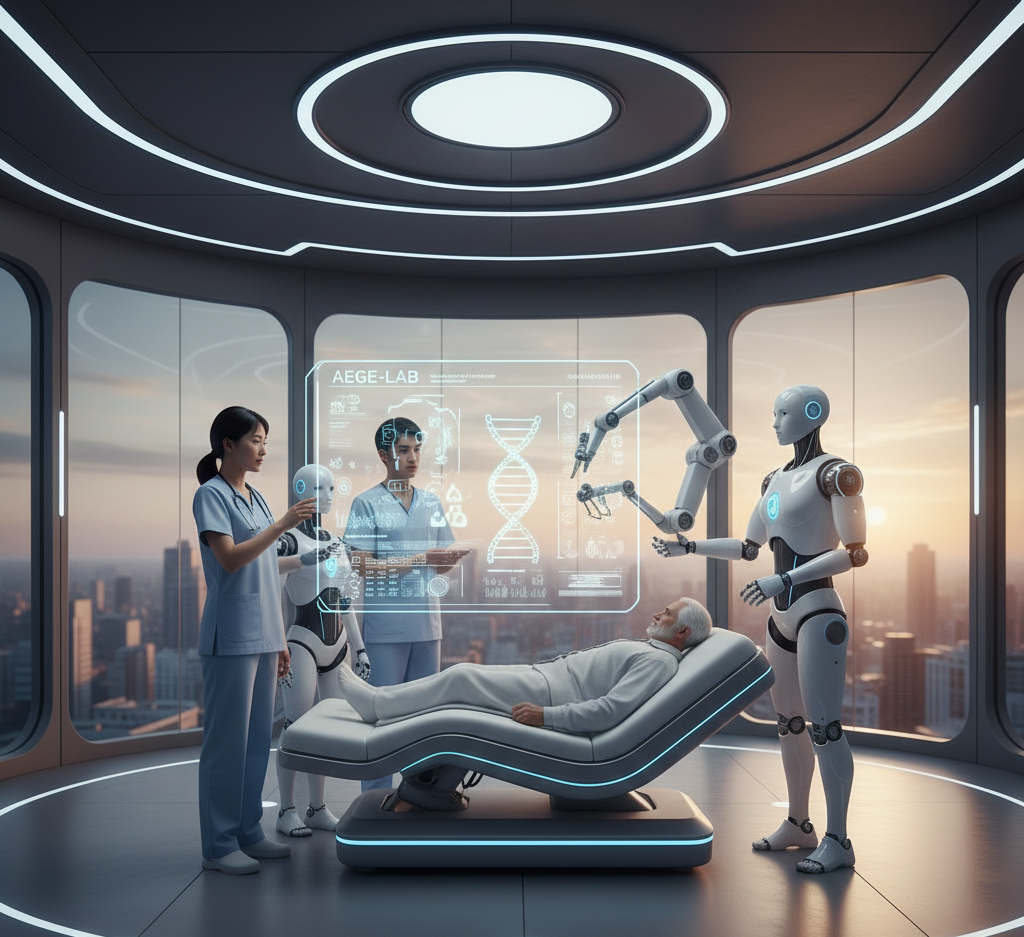
1. 2027: The Frontline of the Robot War Shifts from Factories to the 'Home'
Through my 26 years leading B2B marketing at Samsung Electronics and my 12 years as a National R&D Evaluator, I have reached a definitive conclusion: The victor of the 2027 Global Robot War will not be decided in the giant factories dominated by industrial robots. Instead, it will be won in the most private spheres of humanity—the 'Home' and the 'Hospital.'
We are moving past the era of buying robots for convenience. We are now entering an era where robots are essential to fill the 'care gap' directly linked to human survival. AEGE-LAB identifies this shift as the most powerful investment frontier in the age of AX (AI Transformation).
2. Why Digital Healthcare is the Essence of the Robot Economy?
It’s not simply about machines replacing humans. By 2027, robots will evolve into 'Mobile Medical Data Terminals,' functioning as a vital life-support system for society.
- Essential Supplementation Beyond Labor Limits: Shortages in medical personnel due to low birth rates and aging populations are an unavoidable reality. From a national crisis management perspective, care and rehabilitation robots are no longer an option—they are an 'Essential Defense Line' against a social catastrophe.
- Real-time Data Sync & Spatial Sovereignty: Historically, healthcare began only when a patient visited a hospital. However, the robot-based healthcare envisioned by AEGE-LAB collects biometric data 24/7 within one's living space. This data will become a core asset, enabling disease prediction and triggering immediate 'Robotic Responses.'
3. Three Business Tipping Points: Changes to Watch
The explosion of the robot economy will manifest in three primary areas:
- Democratization of Care-Bots: As mass production lowers the cost of humanoid robots below the cost of hiring a human caregiver, the structure of the silver industry will be shaken to its core.
- Normalization of Remote Robotic Surgery: Leveraging the ultra-low latency of 6G communication, precision surgical robots will overcome geographical barriers, realizing global medical equalization.
- Everyday Wearable Robots: Robotic clothing that supplements the muscle strength of the elderly will re-integrate seniors into the economically active population, providing new flexibility to the labor market.
"For more detailed robotic technology analysis, please visit our [Robotics Specialized Base]."
4. Strategic Implications: He Who Controls the Platform Owns the Future
AEGE-LAB provides a clear strategic direction for corporations and investors. The ultimate competition will not be over the 'machine' itself, but over the 'Medical Data Platform' that the robot collects and analyzes.
While Medical Agentic AI is currently in its early stages of adoption, its implementation is inevitable for global competitiveness. Looking ahead, establishing the 'Medical Robot & Agentic AI Guidelines'—which clarify accountability for robotic surgeries and medical acts—will be the yardstick for business credibility and trust.
✍️ Dr. Paul Kim (Hang-seop Kim), Ph.D.
- Director of AEGE-LAB / Ph.D. in Information Systems, Yonsei University
- Formerly: 26 years at Samsung Electronics & Samsung Human Resources Development Center
- Currently: National R&D Evaluation Member (12th Year)
- Currently: Professor, Graduate School of Health & Medical Management, CHA University
[Request for Expert Insights]
What are your thoughts on the shift in the robot economy discussed in my books, 2027 Robot War and A Healthy Journey with an AI Doctor? I look forward to the sharp insights of experts regarding the ethical and economic issues that arise when robots penetrate the most private areas of human life.